Month: April 2026

THOR’S DAY

On this day in 1789, George Washington was inaugurated as the first President of the United States under the newly-ratified constitution. The inauguration was held nearly two months after the beginning of the first four-year term of George Washington as president. Chancellor of New York Robert Livingston administered the presidential oath of office on the balcony of Federal Hall in New York City.

On April 6, the House and Senate first met in joint session and certified that Washington and Adams were elected as President and Vice-President respectively. Secretary of the Continental Congress Charles Thomson was appointed by the Senate to deliver to Washington the letter containing the news of his election.[5] Thomson delivered the official notification to Washington at Mount Vernon on April 14, 1789. Washington replied immediately, and set out two days later for New York City.

Along the way, Washington received triumphal welcomes in almost every town he passed through. These included Alexandria; Georgetown, Maryland (now part of Washington D.C.); Baltimore; and Havre de Grace.

George Washington had to borrow money just to get to New York City, which was the capital at the time. Although he owned 60,000 acres of land and 300 slaves, Washington had little in the way of cash, and could not get any by trading with other landowners, as they were equally strapped for cash. Washington said to his nephew that the salary was at least part of the reason why he accepted the presidency, “as my means are not adequate to the expense at which I have lived since my retirement.”

“Inauguration of George Washington”, 1898 painting by Ramon Elorriaga


BADA BING!

Before therapy: I hate everyone. After therapy: I am okay with hating everyone.

Silly putty implies the existence of serious putty, otherwise known as C-4 or Semtex.

A shop assistant fought off an armed robber with his labelling gun. Police are now looking for a man with a price on his head.

Sometimes I feel like my brain has a lot of things to hold and no pockets.


The advantage of exercising every day is that you die healthier.  


If you are going to try cross-country skiing, start with a small country. 

The past, present and the future walk into a bar. It was tense! 

When I’m stressed, I like to iron clothes. It’s a great way to let off steam.

What’s a zoo vet’s biggest problem? A giraffe with a sore throat.


Today is the birthday, in 1962, of Robert Reynolds, bassist from the American band The Mavericks who had the 1998 UK No.4 single ‘Dance The Night Away’. The Mavericks won a Grammy Award for the song ‘Here Comes the Rain’. https://www.youtube.com/watch?v=-UajuBAUkBs
Posted by Tom, 0 comments

feeling very WEDNESDAY today

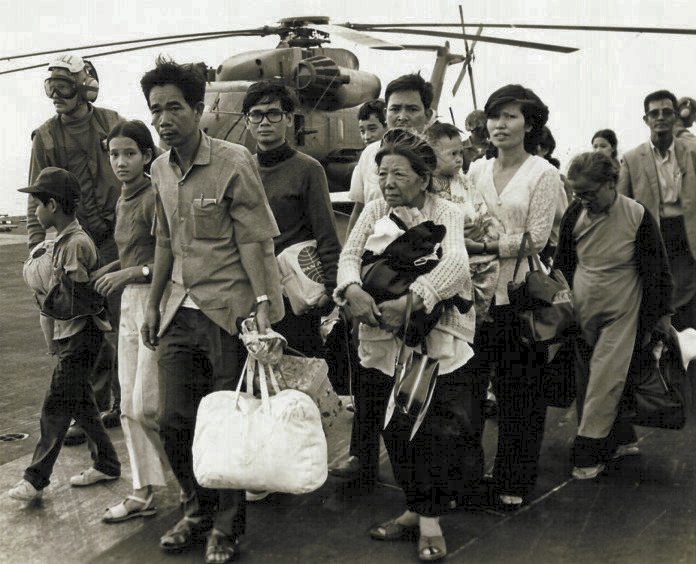
This day in 1975 was the first day of Operation Frequent Wind, the evacuation of American civilians and “at-risk” Vietnamese from Saigon, South Vietnam, before the takeover of the city by the North Vietnamese People’s Army of Vietnam. More than 7,000 people were evacuated by helicopter from various points in Saigon.

At the beginning of March, fixed-wing aircraft began evacuating civilians from Tan Son Nhat Airport through neighboring countries. By mid-April, contingency plans were in place and preparations were underway for a possible helicopter evacuation. As the imminent collapse of Saigon became evident, the U.S. Navy assembled Task Force 76 off the coast near Vũng Tàu to support a helicopter evacuation and provide air support if required.

On 28 April, Tan Son Nhut Air Base (next to the airport) came under artillery fire and attack from Vietnamese People’s Air Force aircraft. The fixed-wing evacuation was terminated and Operation Frequent Wind began. During the fixed-wing evacuation 50,493 people (including 2,678 Vietnamese orphans) were evacuated from Tan Son Nhut.

The evacuation took place primarily from the Defense Attaché Office compound, beginning around 14:00 on 29 April, and ending that night with only limited small arms damage to the helicopters. The U.S. Embassy in Saigon was intended to be only a secondary evacuation point for embassy staff, but it was soon overwhelmed with evacuees and desperate South Vietnamese. The evacuation of the embassy was completed at 07:53 on 30 April, but some Americans chose to stay or were left behind and some 400 third-country nationals were left at the embassy.

South Vietnamese refugees arrive on a U.S. Navy vessel during Operation Frequent Wind.


today is the birthday, in 1947, of Tommy James, The Shondells, from American rock band, Tommy James & The Shondells who had the 1966 US No.1 single ‘Hanky Panky’, the 1968 UK No.1 single ‘Mony Mony’ and the hit ‘I Think We’re Alone Now’. https://www.youtube.com/watch?v=pkMgs3lFwkQ

Posted by Tom, 0 comments

TUESDAY – according to my calendar

On this day in 1789, acting Lieutenant Fletcher Christian, leading disaffected crewmen, seized control of HMS Bounty from the captain, Lieutenant William Bligh, and set him and eighteen loyalists adrift in the ship’s open launch. Bligh navigated more than 3,500 nautical miles (6,500 km; 4,000 mi) in the launch to reach safety. He then began the process of bringing the mutineers to justice. The mutineers variously settled on Tahiti or on Pitcairn Island.

After Bligh reached England in April 1790, the Admiralty dispatched HMS Pandora to apprehend the mutineers. Fourteen were captured in Tahiti and imprisoned on board Pandora, which then searched without success for Christian’s party that had hidden on Pitcairn Island. After turning back towards England, Pandora ran aground on the Great Barrier Reef, with the loss of 31 crew and four Bounty prisoners. The ten surviving detainees reached England in June 1792 and were court-martialed; four were acquitted, three were pardoned, and three were hanged.

Christian’s group remained undiscovered on Pitcairn until 1808, by which time only one mutineer, John Adams, remained alive. His fellow mutineers, including Christian, were dead, killed either by one another or by their Polynesian companions. No action was taken against Adams. Descendants of the mutineers and their accompanying Tahitians have lived on Pitcairn into the 21st century.

Fletcher Christian and the mutineers set Lieutenant William Bligh and 18 others adrift, depicted in a 1790 aquatint by Robert Dodd


Today is the birthday, in 1945, of American drummer John Wolters who was a member of Dr. Hook & the Medicine Show (shortened to Dr. Hook in 1975). They had the 1972 UK No.2 and US No.5 single ‘Sylvia’s Mother’ and in the same year a hit with ‘The Cover of Rolling Stone’. Wolters died of liver cancer on 16 June 1997. https://www.youtube.com/watch?v=uVXVO_vF2Io

Posted by Tom, 0 comments

Happy MONDAY, boys and girls!

On this day in 1953, General Mark Clark announced the beginning of Operation Moolah. It was an effort during the Korean War to obtain through defection a fully capable Soviet MiG-15 jet fighter.

Communist forces introduced the MiG-15 to Korea on November 1, 1950. USAF pilots reported that the performance of the MiG-15 was superior to all United Nations aircraft, including the USAF’s newest plane, the F-86 Sabre. The operation focused on influencing Communist pilots to defect to South Korea with a MiG for a financial reward. The plan set forth an offer of $100,000 (equivalent to $1,093,781 in 2022) for a Soviet MiG-15 and political asylum for the pilot.

On March 20, 1953, the Joint Chiefs of Staff approved the plan. The approved operation was forwarded on April 1, 1953, to the Joint Psychological Committee at FEAF in Tokyo, Japan, where it was staffed, approved, and advanced to Clark. He dubbed the plan Operation Moolah. The plan offered $50,000 to any pilot who flew a fully mission capable MiG-15 to South Korea. The first pilot to defect would be awarded an additional $50,000. The plan also included complete political asylum, resettlement in a non-Communist country, and anonymity if desired.

On April 26, armistice negotiations between Communist forces and the UN began. Clark issued the offer of Operation Moolah on the 27th to coincide with Operation Little Switch, the exchange of sick and wounded POWs between the Communist and the UN forces. General Clark announced the offer on April 27, 1953, through a shortwave radio transmission. The transmission, translated into Korean, Mandarin, Cantonese, and Russian, was broadcast by 14 radio stations in Japan and South Korea into North Korea and China. Clark stated: “To all brave pilots who wish to free themselves from the Communist yoke and start a new, better life with proper honor … you are guaranteed refuge, protection, humane care and attention. If pilots so desire, their names will be kept secret forever …”

On the night of April 26, 1953, two B-29 Superfortress bombers dropped 1.2 million leaflets over Communist bases in the Yalu River Basin. These leaflets were written in Russian, Chinese, and Korean. The Korean Armistice Agreement was signed on July 27, 1953, ceasing all combat operations. Not one single pilot had defected to South Korea.

Early in the morning on September 21, 1953, Lieutenant No Kum-Sok flew a MiG-15bis, bort number ‘Red 2057’, of the 2nd Regiment, Korean People’s Air Force, from Sunan Air Base, just outside Pyongyang, North Korea and landed before 10:00 a.m. at Kimpo Air Base in South Korea. He was immediately taken into the base headquarters for interrogation and physical examination. The next morning, South Korean newspapers mentioned the defecting North Korean pilot and his award of $100,000. No, though, was unaware of Operation Moolah and its rewards. In the aftermath of No’s defection, five of his fellow pilots were executed.

MiG-15 pilot Lieutenant No Kum-Sok, pictured in 1953 wearing typical North Korean flight clothing.


Today is the birthday, in 1959, of Scottish singer, recording artist and actress Sheena Easton, who had the 1980 UK No.3 & 1981 US No.1 single ‘Morning Train, Nine To Five’. Easton’s other hits include the James Bond theme ‘For Your Eyes Only’, ‘U Got the Look’ with Prince and ‘We’ve Got Tonight’ with Kenny Rogers. https://www.youtube.com/watch?v=S_3vZYOYNYU

Posted by Tom, 0 comments

FRIDAY! It’s a good day…

Today is the anniversary of the Mass Trespass of Kinder Scout, which took place in 1932. The protest sought to highlight that walkers were denied access to areas of open countryside which had been fenced off by wealthy landowners who forbade public access. Although the mass trespass was a controversial strategy at the time, the imprisonment of some of the trespassers led to public outrage, which increased public support for open access land.

In 1932 the Kinder Scout in the Peak District was exclusively kept for grouse shooting by the landowner, the Duke of Devonshire. The Duke employed gamekeepers year-round to patrol his land and keep walkers out, despite the fact that he only used the land for a few days each year. A few weeks prior to the mass trespass a group of frustrated walkers were chased off the Duke’s land by his gamekeepers.

Unhappy with a lack of progress by mainstream ramblers groups, on 24th April 1932, between 400–600 workers set off on a walk up Kinder Scout. They were organised by the British Workers’ Sports Federation, a Communist-influenced group, and many of those who joined the Kinder mass trespass were also members of the Young Communist League. The protest aimed to highlight that walkers were denied access to areas of open countryside which had been fenced off by wealthy landowners who forbade public access. As expected, the walkers were met by a line of gamekeepers, and when entry was refused, a fracas broke out. Ultimately, the gamekeepers were overwhelmed and the walkers continued on to their destination, the Kinder plateau.

The general outrage that greeted the arrest and sentencing of the walkers was a catalyst for the passing of the National Parks and Access to the Countryside Act in 1949, which effectively created protected national parks. Fittingly, in 1951 the Peak District became Britain’s first national park and agreements for access to Kinder Scout were negotiated the following year. Walkers’ rights to travel through common land and uncultivated upland were eventually protected by the Countryside and Rights of Way Act (CROW Act) of 2000. Though controversial when it occurred, it has been interpreted as the embodiment of “working class struggle for the right to roam versus the rights of the wealthy to have exclusive use of moorlands for grouse shooting.”


A lot of optimism here….


Today is the birthday, in 1948, of Steve York who with Manfred Mann had the 1964 UK & US No.1 single ‘Do Wah Diddy Diddy’ and the 1968 UK No.1 & US No.10 single ‘Mighty Quinn’. https://www.youtube.com/watch?v=Uc0x7xOap4I

Posted by Tom, 0 comments